
Battle Brief Thursday | Secure the Belt: Counterfeit Truth Is Still a Lie
A Bible verse, some Christian vocabulary, and a confident delivery do not automatically make something biblical. Secure the Belt before somebody trips over the theology.

The most dangerous theological error may not be completely false. It may be almost true.
“Stand, therefore, with truth like a belt around your waist...”
— Ephesians 6:14, CSB
We have spent this week talking about loose theology.
How it happens.
How to test it.
How the Bereans investigated what they were taught.
Today we bring all of that into Basic Battle Training.
Because theological discernment is not merely an academic exercise.
It is part of spiritual readiness.
And there is one piece of the Armor of God that sits directly at the center of everything we have discussed.
The Belt of Truth.
But we need to clarify something.
Wearing the Belt of Truth does not simply mean:
“I believe true things.”
It means truth has become the standard by which everything else is evaluated.
That distinction matters.
Because deception rarely introduces itself by saying:
Hello.
I am deception.
Please abandon everything God said and believe this obviously ridiculous alternative.
That would make spiritual warfare considerably easier.
Instead, deception often works by taking something true...
and moving it slightly.
A verse without context.
A promise without conditions.
Grace without obedience.
Obedience without grace.
Love without holiness.
Holiness without mercy.
Faith without fruit.
Works without faith.
Truth without love.
Love without truth.
Each may contain something biblical.
And still become distorted.
That is why the Belt must be secured.
THREAT ASSESSMENT: COUNTERFEIT TRUTH
Counterfeit money works for one reason.
It resembles real money.
Nobody successfully counterfeits a twenty-dollar bill by printing:
MONOPOLY BANK
THIS IS DEFINITELY NOT MONEY
across the front.
The deception depends on similarity.
Spiritual deception often works the same way.
The most convincing theological errors usually contain enough truth to sound familiar.
Enough Scripture to sound biblical.
Enough Christian vocabulary to sound orthodox.
Enough emotional appeal to sound compassionate.
Enough logic to sound reasonable.
That is why discernment requires more than asking:
“Is there anything true here?”
The better question is:
Is the whole claim faithful to Scripture?
That is a much harder test.
INTELLIGENCE REPORT: THE ENEMY KNOWS SCRIPTURE
Matthew 4 should permanently destroy the idea that quoting Scripture automatically makes someone’s argument biblical.
During Jesus’ temptation, Satan said:
“If you are the Son of God, throw yourself down. For it is written:
He will give his angels orders concerning you,
and they will support you with their hands
so that you will not strike your foot against a stone.”
— Matthew 4:6, CSB
Satan quoted Psalm 91.
Accurately enough to make his argument sound biblical.
Think about that.
The enemy did not approach Jesus with pagan philosophy.
He approached Him with Scripture.
The problem was not the verse.
The problem was what Satan was doing with the verse.
He took a true promise about God’s protection and twisted it into justification for testing God.
Jesus answered:
“It is also written: Do not test the Lord your God.”
— Matthew 4:7, CSB
There is our tactical lesson.
Scripture must be interpreted within Scripture.
Jesus did not reject Psalm 91.
He rejected Satan’s misuse of Psalm 91.
That is an important distinction.
The verse was true.
The theology built from it was false.
Counterfeit truth.
ARMOR ANALYSIS: WHAT DOES THE BELT ACTUALLY DO?
Paul begins his description of the Armor of God with truth:
“Stand, therefore, with truth like a belt around your waist...”
— Ephesians 6:14, CSB
In the equipment of a Roman soldier, the belt helped secure clothing and supported equipment needed for movement and readiness.
Loose clothing could interfere with action.
Things needed to be secured.
That imagery becomes particularly useful when we think about theology.
Loose theology creates vulnerability.
Unexamined assumptions.
Verses detached from context.
Doctrines inherited but never investigated.
Popular teachings accepted because everyone repeats them.
Christian slogans that sound biblical but may not actually appear anywhere in Scripture.
Secure the loose material.
Truth does that.
The Belt of Truth helps bring everything into alignment with what God has actually revealed.
Not what we wish He said.
Not what culture says He should have said.
Not what our denomination assumes He said.
Not what our favorite teacher said He said.
What He actually said.
THE BELT IS NOT A COLLECTION OF FACTS
This is where we need to go deeper.
You can know many true biblical facts and still be vulnerable to deception.
Satan knew Scripture.
The Pharisees knew Scripture.
Jesus told religious leaders:
“You pore over the Scriptures because you think you have eternal life in them, and yet they testify about me.”
— John 5:39, CSB
Information alone does not guarantee discernment.
The Belt of Truth is not biblical trivia strapped around your waist.
Truth must shape:
how you think,
how you evaluate,
how you interpret,
how you respond,
and how you live.
The question is not merely:
Do I know Scripture?
The question is:
Has Scripture trained me to recognize what does not fit?
That is a different level of readiness.
COUNTERFEIT DETECTION REQUIRES KNOWING THE REAL THING
There is an old illustration often used about counterfeit detection:
Study genuine currency closely enough, and abnormalities become easier to recognize.
The illustration can sometimes be oversimplified—actual counterfeit detection involves specific security features, tools, and training—but the underlying principle still works.
You need a reliable standard.
You cannot identify distortion if you do not know what something is supposed to look like.
The same applies to theology.
If your biblical knowledge consists primarily of:
sermon clips,
social media posts,
devotionals,
Christian books,
podcasts,
and inspirational graphics,
you may know many things about Christianity.
But you may still struggle to recognize when Scripture is being distorted.
Those resources can be useful.
I use them too.
But none of them replaces knowing Scripture itself.
You need enough exposure to the whole counsel of God that something begins to feel wrong when a teaching contradicts it.
Then you investigate.
Which brings us directly back to yesterday.
Anakrinō.
Examine.
Investigate.
Ask:
Are these things so?
TACTICAL ERROR #1: THE SINGLE-VERSE DOCTRINE
One common vulnerability is building an entire theological claim on one isolated verse.
A verse is quoted.
A conclusion is announced.
Everyone moves on.
Not so fast.
Ask:
What comes before it?
What comes after it?
Who is speaking?
Who is being addressed?
What type of literature is this?
How does this passage fit the argument of the book?
What do other Scriptures say about the same subject?
A doctrine may certainly be expressed clearly in one verse.
But our understanding of that doctrine should still survive comparison with the rest of Scripture.
If your theology requires one verse to fight twelve others...
something is loose.
Secure it.
TACTICAL ERROR #2: THE HALF-TRUTH
Half-truths are especially dangerous because the true half provides credibility.
Consider statements like:
“God is love.”
True.
Therefore God would never judge anyone.
Not true.
“Christians are saved by grace.”
Absolutely.
Therefore obedience does not matter.
No.
“Christians should pursue holiness.”
Yes.
Therefore salvation depends on achieving sufficient moral performance.
Also no.
“God wants us to trust Him.”
Yes.
Therefore any fear or anxiety proves we lack faith.
No.
Each error begins with something true.
Then it extends that truth beyond what Scripture supports.
The Belt of Truth requires us to hold biblical truths together.
Not select one truth and use it to erase another.
TACTICAL ERROR #3: THE EMOTIONAL OVERRIDE
This one is harder.
Sometimes a teaching feels right.
It sounds compassionate.
Comforting.
Hopeful.
Fair.
Empowering.
And therefore we assume it must be biblical.
But emotion is not our final authority.
Neither is discomfort evidence that something is false.
Scripture sometimes comforts us.
Sometimes it confronts us.
Sometimes it reassures us.
Sometimes it corrects us.
Sometimes it tells us exactly what we hoped to hear.
Sometimes it absolutely does not.
The Belt of Truth means we allow Scripture to correct our feelings rather than requiring Scripture to agree with them.
That does not mean emotions are irrelevant.
It means they are not commanding officers.
TACTICAL ERROR #4: BORROWED CONVICTIONS
Many Christians believe true things for reasons they have never personally examined.
That is not necessarily bad.
We all begin by learning from someone.
But borrowed convictions can become vulnerable convictions.
If someone asks:
“Why do you believe that?”
and our only answer is:
“My church teaches it,”
we may believe something completely true.
But we are not yet well equipped to defend or evaluate it.
The Bereans give us another model.
They received teaching eagerly.
Then they examined Scripture daily.
Eventually, inherited theology needs to become examined theology.
Not because we assume our teachers were wrong.
Because truth deserves to be known firsthand.
ARMOR CHECK: IS YOUR BELT SECURED?
Ask yourself:
Do I regularly read Scripture beyond isolated verses?
Can I explain why I believe my core doctrines from Scripture?
When I encounter a teaching I agree with, do I test it as carefully as one I dislike?
Am I willing to change my theology if Scripture requires it?
Do I know the difference between Scripture, interpretation, inference, and tradition?
Am I learning the whole counsel of God—or mainly consuming passages I already like?
Those questions reveal whether truth is functioning as armor...
or merely information.
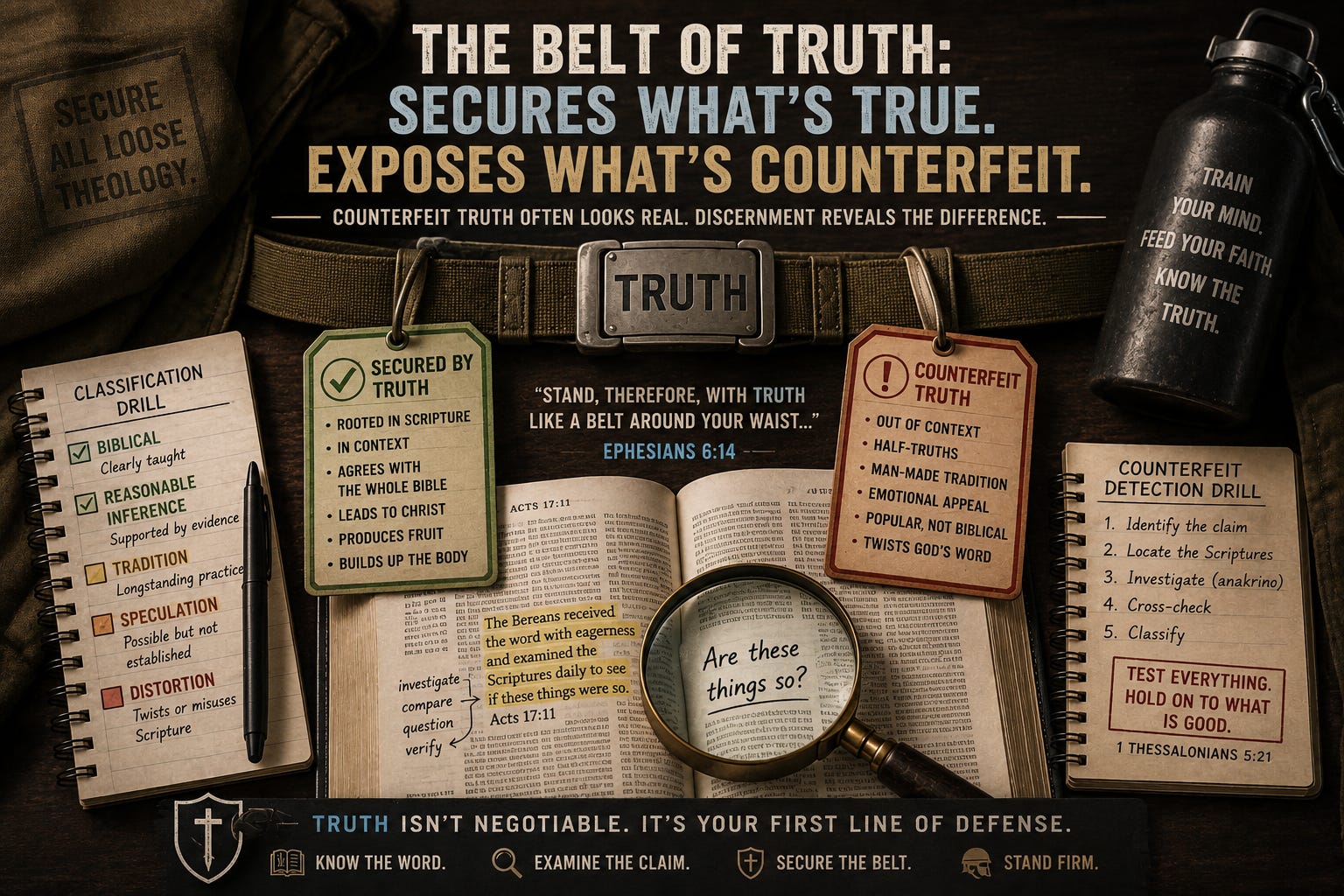
FIELD EXERCISE: COUNTERFEIT DETECTION DRILL
This week, choose one Christian statement you encounter.
Preferably one that sounds completely reasonable.
Do not choose something obviously absurd.
That is too easy.
Choose something that sounds biblical.
Then run the drill.
STEP 1: IDENTIFY
Write the claim in one sentence.
What exactly is being asserted?
STEP 2: LOCATE
Find the Scriptures used to support it.
STEP 3: INVESTIGATE
Anakrinō.
Read those passages in context.
STEP 4: CROSS-CHECK
Find other Scriptures addressing the same subject.
Especially passages that might complicate your initial conclusion.
STEP 5: CLASSIFY
Is the claim:
Biblical — clearly supported by Scripture?
Reasonable inference — not explicitly stated but supported by biblical evidence?
Tradition — a longstanding belief or practice that may or may not have direct biblical command?
Speculation — possible, but not established by Scripture?
Distortion — built from Scripture but contrary to its context or broader teaching?
That classification alone can secure a surprising amount of loose theology.
RULES OF ENGAGEMENT
When you discover questionable theology, remember:
Not every error requires a public battle.
Not every disagreement is heresy.
Not every imperfect statement proves someone is a false teacher.
Not every theological difference requires you to deploy the Caps Lock of Righteousness.
Sometimes the correct response is:
Study more.
Ask a question.
Seek clarification.
Correct privately.
Disagree graciously.
Or simply refuse to adopt the teaching.
Discernment includes knowing not only what is true...
but how to respond when something is not.
Truth does not need us to become obnoxious in its defense.
SECURE ALL LOOSE THEOLOGY
The Belt of Truth comes first in Paul’s description of the Armor for good reason.
Everything must be secured by truth.
Because deception does not always look ridiculous.
Sometimes it looks biblical.
Sometimes it quotes Scripture.
Sometimes it comes from someone we trust.
Sometimes it agrees with something we already believe.
And sometimes...
the loose theology is ours.
That is why we test.
That is why we investigate.
That is why we compare Scripture with Scripture.
That is why we keep learning.
And that is why we remain willing to say:
“I may need to rethink that.”
That sentence is not evidence of weak faith.
Sometimes it is evidence that truth matters more to us than being right.
So secure the Belt.
Know the Word.
Investigate the claim.
Test the interpretation.
Hold onto what is good.
And when something does not survive Scripture?
Let it go.
The battlefield is difficult enough without tripping over your own loose theology.
FIELD ORDER
This week:
Do not merely ask whether a teaching contains truth.
Ask whether the whole teaching is faithful to truth.
Because a counterfeit does not need to be completely false.
It only needs to be convincing enough to pass unnoticed.
Secure the Belt.
Then stand.